

Terminology
Journey
Journey: A Journey is a configurable, directed graph that Entities traverse as part of a Journey Application. When all Entities reach the end of the graph, a Journey Application Outcome is reached. This outcome signals to you what should be done with the applicants in your system.
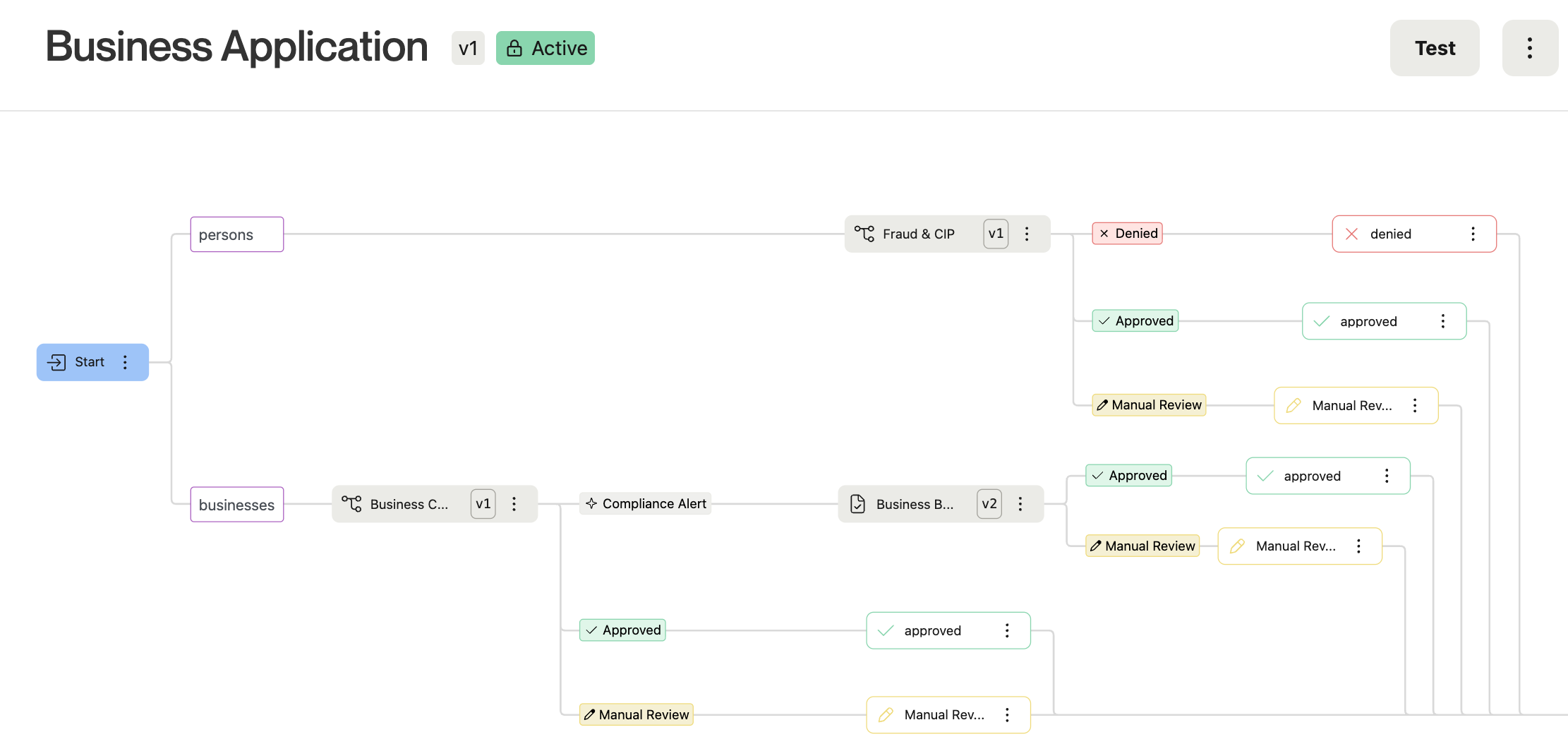
Here is an example of a Journey that onboards a business and the people connected to the business. Reference this as you read through the following terms.
Branches: Branches represent different pathways that you can send Entities down. The branch that an Entity will travel down is defined as part of the Entity's payload for the Journey Application.
After hitting the first Node in the Journey, the Entity will then be routed by each Node's outcome. Read more about this under Outcome Edges below.
The branches can be used to separate different types of Entities (person or business), they can be for different geographic regions, or they can be used for any other form of differentiation that you wish to define.
Branches are independent of one another, allowing you to configure your policy differently for each.
In the above image, the two branches are persons and businesses.
Outcome Edges: Outcome Edges lead out of the right side of each Node. These edges are defined by the potential outcomes of the Node (more information on this below).
When the Entity reaches an outcome in the Node, its next step is to traverse the Outcome Edge corresponding to the Node's outcome. This will lead it to the next Node in the Journey graph.
Nodes: A Journey is composed of many Nodes in a directed graph structure. As in a graph structure, each Node has one Outcome Edge leading to it and multiple Outcome Edges leading from it.
An Entity progresses through its Branch of the Journey like so:
- Entity reaches a Node
- The Entity is evaluated by the Node and reaches an outcome
- The Entity travels down the Edge that corresponds with the outcome of the Node
- The Entity reaches another Node (back to step 1)
- Eventually, the Entity hits an Outcome Node. The Entity Application is given this as its Entity Application Outcome.
There are several different kinds of Nodes, which are detailed below.
Workflow Nodes: These nodes define your policy. They are completely configurable and cover a single Entity at a time, producing an Evaluation record upon completion.
The workflow takes data from calls to external services and from your Journey Application payload. It uses this data to evaluate thresholds you define, ending with an decision. This decision, also called an outcome, guides the Entity to the next step of the Journey.
Step Up Nodes: If a customer’s identity needs to be verified, you can use a Step Up Node. These are very similar to Workflow Nodes, but they require a document, such as a selfie, to be sent to Alloy. This can be done using the Update Journey Application endpoint.
Action Nodes: There may be times when you want to account for an event that is not directly handled by the Alloy system, such as extending an offer to a customer. Action Nodes can be used for this purpose. They pause the Entity Application until an API request is received by Alloy. This request provides the Action Node's outcome and any additional data for the Entity Application.
Manual Review Nodes: Sometimes you need a human to examine an Entity or Journey Application to make a decision. In this case, you can use a Manual Review Node. When this Node is reached, one of your agents must enter the Alloy dashboard and look at the data points collected across the prior steps of the Journey. This can include data service responses, documents collected, and Evaluation results. Once the agent is ready, they may provide a decision for this step of the Journey.
Outcome Nodes: These are the nodes that appear at the end of a path that an Entity travels along. They represent the Entity Application Outcome. Once an Entity reaches an Outcome Node, it is complete.
If there is more than one Entity in a Journey Application, the Entity Application Outcome will not necessarily be the same as the Journey Application Outcome. This is due to logic defined in the Reconciliation Node.
Reconciliation Node: This is a type of Workflow Node that appears at the end of the Journey and determines the Journey Application Outcome. Reconciliation Nodes are only used in Journey Applications with multiple Entities. The logic is typically based on a combination of the Entity Application Outcomes, but the logic is configurable. It can also take more factors into account, such as a combined risk score from all of the Entities.
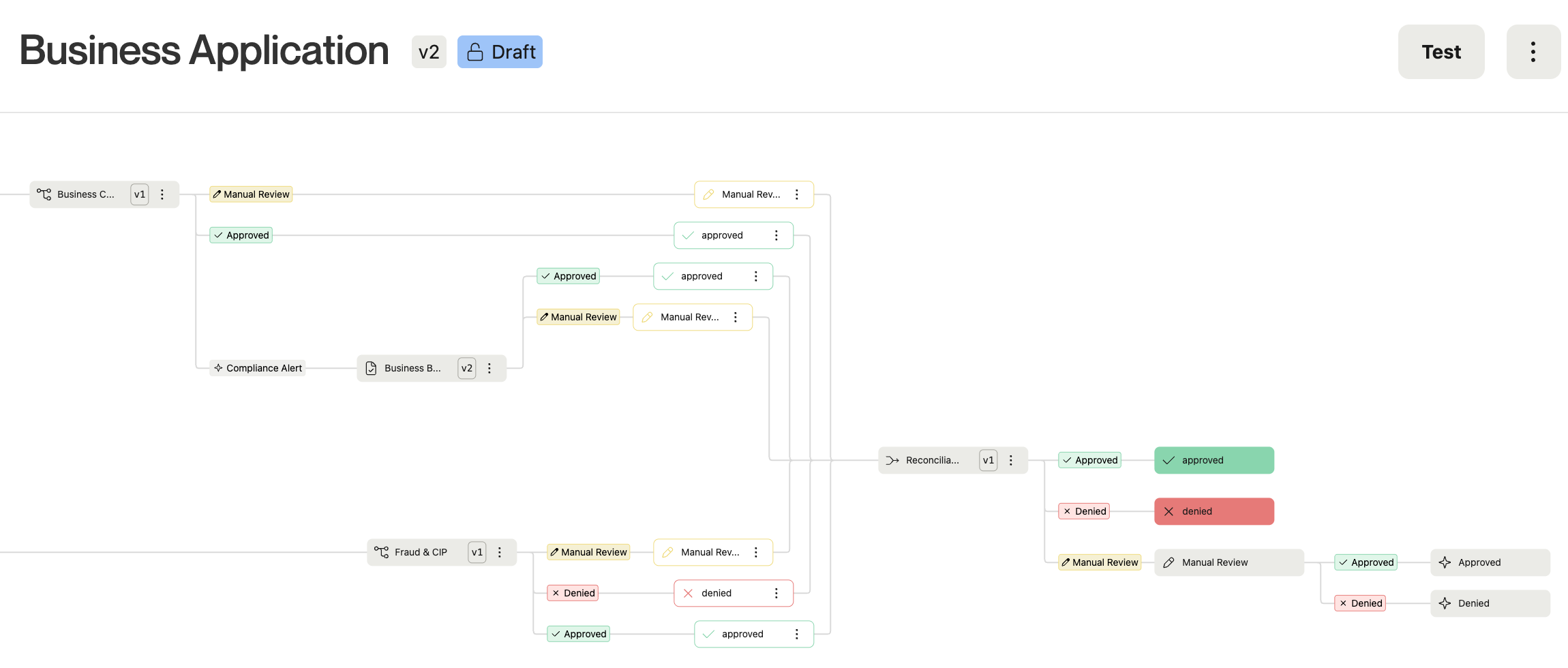
Here is the rest of the Journey pictured above. It feeds each Entity Application Outcome into the Reconciliation Node. The Reconciliation Node then reaches an outcome or goes into Manual Review.
Journey Application
Journey Application: The record of one or more Entities traversing the Journey graph.
Journey Application Status: A representation of the current state of the Entity or group of Entities traveling through the logic of the Journey; the state of the Journey Application as a whole.
Journey Application Outcome: The overall decision of the Journey Application. For Journey Applications with only one Entity, this is the same as the Entity Application Outcome. For Journey Applications with multiple entities, it is reached within the Reconciliation Node.
Entity Application
Entity Application: An Entity Application represents each Entity that is part of the Journey Application. Entity Applications run through the Journey independently and reach an outcome. These outcomes are then reconciled in the Reconciliation Node to produce the Journey Application Outcome.
Entity Application Status: The state of an individual Entity within a Journey Application. The state changes as the Entity travels through the Nodes of the Journey.
Entity Application Outcome: The decision made for an individual Entity Application. This is defined by the Outcome Node that the Entity Application reaches.
Misc.
Evaluation: The record created after an Entity reaches a Workflow Node. The Evaluation contains the tags set in the workflow, information returned from data services, and more. It ends with an outcome, which is used by the Journey to route the Entity down the appropriate Edge.
Updated 4 months ago